
How Cobb County Built a Middle School Student Media Program (and Why It Strengthens the CTE Pipeline)
In brief: Cobb County School District built a broadcast-quality student media studio and control room at Tapp Middle School so students develop production skills before high school. The result is a stronger CTE broadcast pathway—freshmen arrive ready for advanced work, leadership, certifications, and competitions.
When should students start learning career-ready media production?
Many districts start media production training in high school because that’s where CTE pathways are tradtionally better funded and staffed.
Cobb County School District asked a different question: What if students arrived in 9th grade already knowing how to run a broadcast?
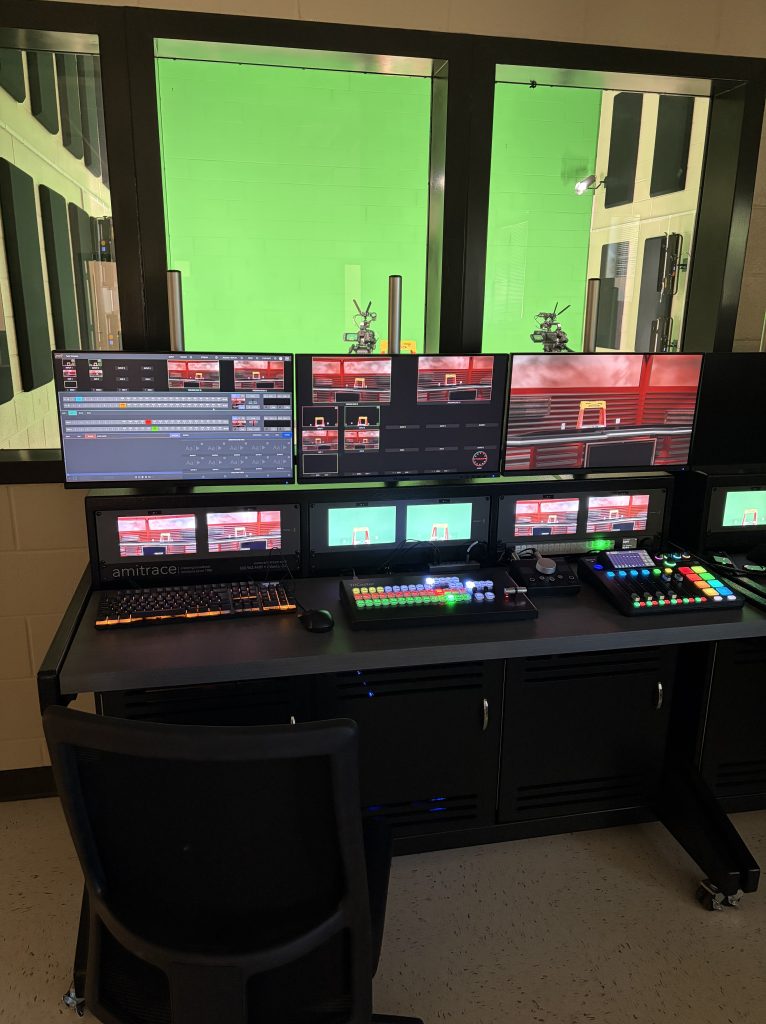
Answer: The district built a new wing complete with an upgraded student media program facility at Tapp Middle School (Powder Springs, GA)—including a green screen studio, a dedicated control room, and a student-friendly production workflow—so middle schoolers can practice real roles before high school.
When Tapp Middle School opened in a newly built facility, Cobb County didn’t just add classrooms—it invested in a broadcast-quality program designed to be usable on day one by students and educators.
Takeaway: Starting earlier creates confident creators—not beginners—when students enter the high school CTE pathway.
How did Cobb County and Amitrace approach a middle school media program?
Cobb County and Amitrace have partnered for many years, designing and installing student media programs across the district.
- They’ve already operated a switcher.
- They know what a rundown is.
- They’ve produced live morning news—and learned how to troubleshoot in real time.
Why it matters: Early, authentic experience builds skills and confidence that translate to advanced coursework and career preparation.
What did Amitrace build at Tapp Middle School?
Amitrace designed and installed a turnkey student media program as part of Tapp Middle School’s new construction, selecting tools and workflows that can produce broadcast-quality results while staying approachable for middle school users.
What’s in the control room?
- Two production consoles: Watson Unlimited three-bay consoles create a multi-operator environment where students rotate roles (director, technical director, audio, graphics).
- Switcher platform: TriCaster Mini X HDMI.
- Routing and monitoring: Blackmagic Design Videohub 40×40 with Master Control Pro, plus SmartView Duo monitors for real-time quality control.
What’s in the studio?
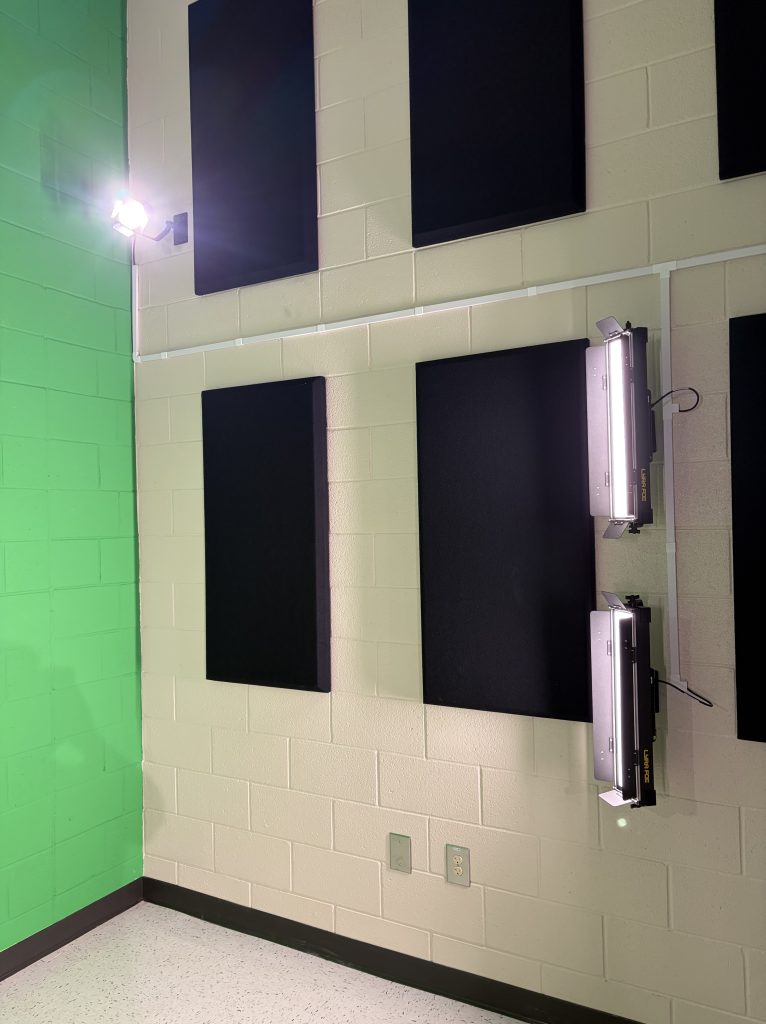
- Green screen environment: Full studio setup designed for student productions.
- Lighting: Wall-mounted studio lights (Lyra POE bi-color LED panels + Lyra POE Fresnel zoom fixtures from Ikan), DMX controlled.
- Cameras: Two Canon XA75 4K camera systems with wireless video transmission from Hollyland.
- Audio: RØDECaster Pro II integrated console with wireless microphone systems and JBL studio monitors.
- Acoustics: 32 acoustic treatment panels for consistent sound quality.

How was the program implemented?
- Complete engineering schematic
- System commissioning
- Custom cable integration for both production consoles
- Onsite installation
- Two staff training sessions
Why does starting in middle school strengthen the CTE pipeline?
When broadcast education starts in 9th or 10th grade, teachers often have to support beginners and advanced students at the same time.
- More advanced instruction sooner: High school teachers can focus on higher-level production techniques instead of basic camera and control-room orientation.
- Stronger student leadership: Experienced freshmen can step into roles and mentor peers.
- More time for outcomes that CTE programs are measured on: certifications, competitions (e.g., SkillsUSA), and postsecondary readiness.
Comparable model: Like athletics or performing arts, a feeder program makes the entire pathway stronger.
What can other districts do to start earlier (without building a full studio)?
Not every district will build a full broadcast facility like Tapp Middle School. Cobb County’s program reflects decades of partnership and sustained district commitment.
Practical ways to start in middle school:
- A simple video podcast workflow in an 8th-grade communications elective
- A shared camera + basic switching setup in a multipurpose space
- A small “VidPod” style setup for morning announcements and student storytelling
Rule of thumb: Every year you start earlier is a year students spend creating—rather than learning how to create.
Question to ask: What would your high school broadcast program look like if freshmen arrived with two years of production experience?
Amitrace has helped districts across the Southeast plan and build student media programs for over 40 years. If you’re exploring a middle school-to-high school broadcast pathway, Amitrace can help scope options that fit your space, staffing, and budget.




Tapp Middle School: program details (quick reference)
| District | Cobb County School District, Georgia |
| School | Tapp Middle School, Powder Springs, GA |
| Program type | Turnkey student media program (studio + control room) |
| Production switching | TriCaster Mini X HDMI |
| Video routing | Blackmagic Videohub 40×40 + Master Control Pro |
| Camera systems | 2× Canon XA75 4K with wireless video |
| Production consoles | 2× Watson Unlimited 3-Bay |
| Audio workflow | RØDECaster Pro II + wireless mics + JBL studio monitors |
| Lighting | IKan LED studio lights, DMX controlled |
| Sound treatment | 32 acoustic panels |
| Implementation | Engineering schematic, Commissioning, Onsite installation, Staff training |
FAQ
What is a student media program?
A student media program is a school-based production environment where students learn to plan, record, edit, and broadcast content (e.g., morning news, announcements, interviews, podcasts, and events).
Why start broadcast/media training in middle school?
Starting in middle school gives students time to practice fundamentals before high school, so CTE teachers can spend more time on advanced skills, leadership roles, and measurable outcomes like certifications and competitions.
Does a district need a full studio to begin?
No. Many districts start with a small, shared setup (camera, basic lighting, simple audio, and entry-level switching or recording) and expand as interest, staffing, and funding grow.
What equipment did Tapp Middle School include?
Tapp’s program includes a dual-console control room, a green screen studio, DMX-controlled lighting, 4K cameras with wireless video, routing/monitoring, and an integrated audio workflow (see “Program details” above for the full list).
What’s the main outcome Cobb County is aiming for?
A stronger high school broadcast pathway: students enter with real production experience, enabling advanced instruction, stronger student leadership, and better preparation for postsecondary programs and careers.
—
Amitrace has created broadcast solutions for school districts since 1986. To learn more about building a sustainable student media program in your district, contact Tom White at tom@amitrace.com or visit amitrace.com.