
Why Student-Run Media Programs Are the Future of CTE
Student-run media programs are one of the most effective ways to modernize Career Technical Education (CTE) because they build communication, technical production, collaboration, and portfolio skills through real projects.
This guide is for CTE directors and school leaders who want to launch or expand a student broadcast, journalism, or video production pathway. Below you’ll find the key benefits, the industry rationale, and a practical step-by-step framework you can use in your school.
What has changed in CTE—and why does media matter now?

Traditional CTE pathways (welding, construction, automotive, healthcare, and more) will always be essential. But across every industry, employers increasingly value people who can communicate clearly, work in teams, and use digital tools to create and share information—not just consume it.
Labor market data (including the U.S. Bureau of Labor Statistics) continues to show steady demand across media, information, and digital content roles. More importantly, media skills are becoming foundational in other fields too: a healthcare worker who creates patient-education videos, an architect who presents designs visually, or a small business owner who tells a story through social content.
Student-run media programs develop these skills through authentic, deadline-driven projects—giving students a real audience and a reason to produce high-quality work.
What students gain from a student-run media program
1) How does student media build communication skills?
- Write with purpose: scripts, stories, interview questions, and narration require clear thinking and audience awareness.
- Listen actively: interviews teach follow-up questioning, nuance, and representing other people accurately.
- Communicate visually: students learn to tell stories with images, pacing, and editing choices.
- Collaborate under pressure: production roles require coordination, delegation, and constructive feedback.
These are transferable skills. When students complete even one broadcast-quality project, they practice professional communication in a way a worksheet can’t replicate.
2) Why does student media increase engagement (especially for different learners)?
Many students don’t thrive in a lecture-first classroom. Media production provides hands-on, visible work with real deadlines—often a better fit for students who need relevance, movement, or a concrete product to stay motivated.
- Students who feel disengaged in traditional classes may participate more when they can be on camera, behind the scenes, or in an editing role.
- Students who struggle with long-form reading/writing can still demonstrate learning through storyboarding, filming, interviewing, and editing.
- Students who benefit from structure often respond well to production roles, checklists, and clear deadlines.
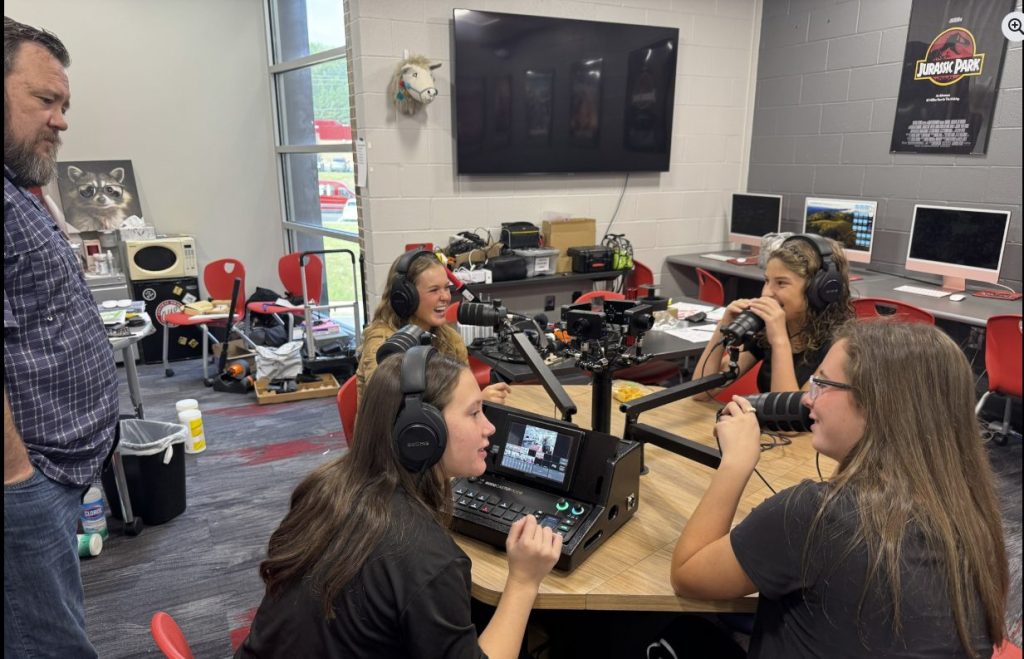
Research on project-based learning commonly finds improved engagement and persistence—particularly when students produce work for an authentic audience.
3) How does student media create real career pathways?
Media programs connect directly to real industries—broadcasting, video production, journalism, podcasting, marketing, and digital content creation.
- Common roles students can explore: videographer, editor, producer, camera operator, sound/AV tech, broadcast talent, social media content creator.
- These roles exist in schools, local government, nonprofits, healthcare, athletics, small business, and media companies—not only “TV stations.”
Most entry points increasingly require evidence of skill. A student media program helps students graduate with a portfolio (clips, segments, interviews, promos, documentaries) they can use for jobs, internships, community college programs, or further training.
For CTE leaders, this means a pathway with clear artifacts, measurable skill growth, and strong employer relevance.

Is student media a trend or a long-term CTE investment?
It’s a long-term investment. Across the country, districts are expanding media, AV, and digital content pathways because they combine high engagement with career-relevant skills.
- Media literacy and digital communication are increasingly treated as core competencies.
- Project-based programs that produce real artifacts (videos, broadcasts, podcasts) tend to show strong student ownership and agency.
- Technology for high-quality production has become more affordable and more school-friendly.
In the past, broadcast-quality production required specialized equipment and expertise. Today, schools can build reliable studios with tools that are easier to learn, easier to manage, and designed for student access—making it realistic to run a program as a class, club, or pathway. Schools that build strong media programs now position students for success in multiple careers—because the skills (communication, teamwork, production, storytelling) travel anywhere.
How to start a student-run media program (practical framework)
If you’re launching from scratch or improving an existing program, use the phased approach below to align stakeholders, design for student access, and ship real projects quickly.
Phase 1 (Months 1–2): Define the mission
Start by agreeing on what success means. Your mission might prioritize:
- Career readiness in media production
- Student voice and engagement
- School communications (announcements, highlights, events)
- Visual support for other classes
- Community connections (interviews, local features)
Then align stakeholders (administrators, counselors, teachers, students, and families) on the purpose, schedule, and expectations.
Phase 2 (Month 3): Design for student access
- Intuitive tools: choose equipment and workflows students can learn quickly (without technical gatekeeping).
- Predictable access: decide whether this is a course, club, or after-school block—and protect the time.
- Structured learning: use a curriculum or project sequence that builds skills progressively.
Phase 3 (Month 4+): Launch with real projects
- A weekly or monthly school broadcast (news, student work, celebrations)
- Community interview series (leaders, alumni, local employers)
- Sports coverage or event documentation
- Short documentaries on student-selected topics
- Marketing/promotional content for school programs
Real projects drive real learning. When students publish or broadcast their work, quality standards rise—and students see that what they make matters.
Phase 4 (Ongoing): Expand and integrate
As the program stabilizes, partner with other departments: co-produce storytelling projects with English, oral histories with history, and explainers with STEM. Over time, the media pathway becomes part of how your school teaches and communicates.
What is the ROI of a student-run media program?
Launching a media program takes investment (equipment, time, and coaching). The payoff is usually visible within a semester because students create work the whole community can see.
- Higher student engagement and persistence
- A visible program that differentiates your school
- Graduates with portfolio-ready work samples
- Stronger participation from students who often disengage in traditional settings
- A platform to amplify student voice and strengthen school culture
That return extends beyond the budget line—because it improves both learning outcomes and schoolwide communication.
Key takeaways
- Student-run media strengthens core CTE outcomes: communication, collaboration, and applied technical skills.
- Programs work well for many learning styles because students produce visible, real-world work on deadlines.
- Media pathways create career-ready portfolios that support jobs, internships, and postsecondary programs.
A simple phased rollout (mission → access → real projects → integration) reduces risk and improves sustainability.
FAQ: Student-run media programs in CTE
Do student media programs count as CTE?
Yes—when structured as a pathway with defined competencies (production, storytelling, audio/video, project management) and portfolio-based assessment, they align well with career-readiness outcomes.
What’s the best way to start if we have limited time?
Start with one repeatable format (e.g., podcasts, a monthly broadcast or short highlight videos). Keep roles simple, use checklists, and ship consistently before expanding.
Do students need expensive gear to produce quality work?
No. Start with what you can support reliably. Clear audio, good lighting, and consistent workflows usually matter more than top-tier cameras.
How do we make the program sustainable?
Protect scheduled access, teach repeatable production routines, and publish on a consistent cadence. Sustainability comes from systems, not one-time enthusiasm.
Your next step
Student-run media programs are quickly becoming a “must-have” pathway because they combine career skills with high engagement. Schools that invest now build capacity that pays off for years.
If you’re deciding when to act, now is a practical time—especially during budget planning. Whether you’re starting from scratch or upgrading an existing program, focus on student access and repeatable projects first.
Talk with students about what they want to create, choose a simple first format, and commit to publishing consistently—then scale from there.